This post is also available in .
A new study published in by Sunny Rai and colleagues, reveals that the linguistic “signatures” of depression are not universal. Drawing on a carefully matched group of English speakers who identified as Black or White in the United States, the researchers found that race profoundly shapes how depression appears in language and. how AI models interpret it.
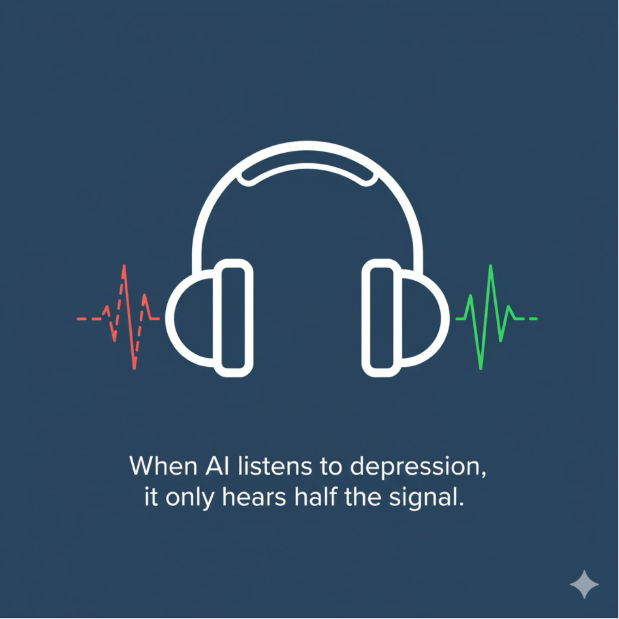
The myth of the “universal” depression marker
For decades, psychologists have pointed out one reliable linguistic clue: people who are depressed tend to use more first-person singular pronouns such as I, me, or my. This pattern was thought to reflect an inward focus typical of depression.
The new study challenges that assumption. Among White participants, people with higher depression scores tended to use “I” words more often. But for Black participants, this link disappeared: their use of “I,” “me,” and “my” did not vary with depression levels. Black individuals also used these words more overall, regardless of mood, suggesting that self-focused language functions differently across racial groups.
One proposed explanation lies in cultural models of self. Many psychological theories assume an independent self-concept, common in European American contexts, where emotion and identity are tightly linked to the individual. In contrast, studies describe a more relational or dual sense of self among many Black Americans, where personal identity is intertwined with community and social context. Counting pronouns simply does not capture that complexity.
When AI listens, it listens selectively
The researchers also explored broader themes in language using topic modeling, a method that groups words based on shared meaning. Among White social media users, depression was tied to five negative emotion themes: outsider belongingness, self-criticism, worthlessness or self-deprecation, anxious outsider, and despair.
For Black users, none of these themes tracked depression severity, and the study did not identify an alternative set that reliably signaled depression in this group.
When the team trained machine learning models to predict depression, the issue became even clearer. A model trained on White users’ posts performed reasonably well on new White data but poorly on Black data. Even a model trained exclusively on Black users’ language struggled when tested on new Black participants and often performed better on White participants instead. The issue, the authors argue, is not only biased training data. The linguistic cues that AI relies on to detect depression simply do not exist in the same way for everyone.
Why it matters and how we can listen better
These findings raise uncomfortable but crucial questions for both AI and psychology. If algorithms trained to “hear” depression only recognize the suffering of some groups, they risk reinforcing racial disparities in mental health care. At the same time, the results challenge long-standing theories built on largely homogeneous samples. A supposedly universal marker like first-person pronoun use may reflect only one cultural expression of distress. As mental health technology becomes more integrated into daily life, this study offers a clear lesson: empathy cannot be automated without attention to diversity. AI systems must learn not only what people say, but how different communities give voice to emotion. If the language of suffering varies across cultures, then so must our tools for recognizing it. The goal is to build systems that are not only smarter but also more attuned, capable of listening without reproducing the blind spots of the past.
Author: Amir Homayun
Buddy: Helena
Editor: Vivek
Translator: Natalie
Editor translation: Lucas
About The Author
