This post is also available in .
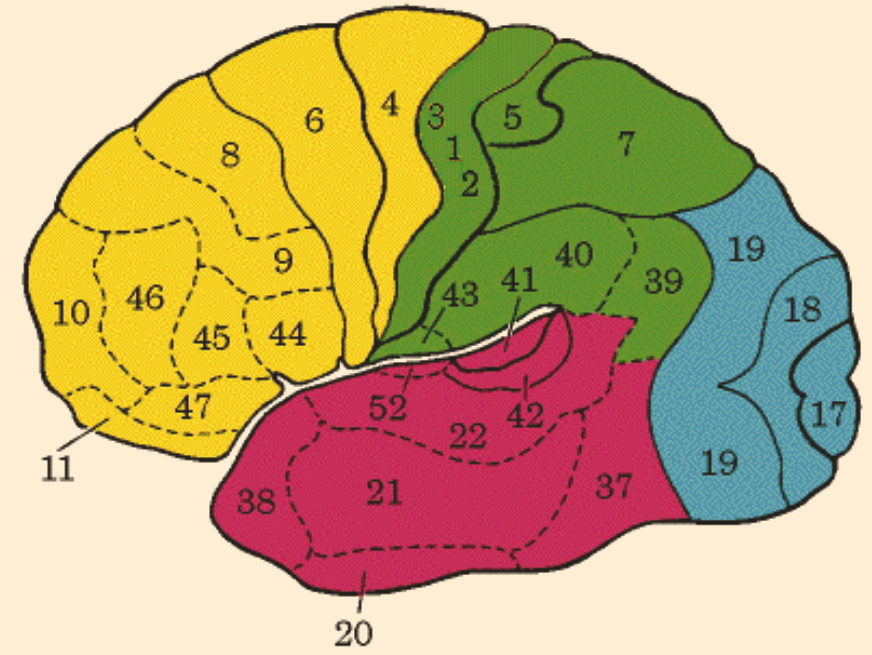
When you think about the brain, you might imagine a map with neatly labelled regions, one part for vision, one for language, another for movement. This picture is appealing because it gives the sense that our mental life can be cleanly divided into separate boxes. But the reality is far more fascinating, and a little messy.
Challenging the View of “One Region, One Function”
An article by Koen V. Haak and Christian F. Beckmann elucidated this puzzle: how does the brain stay organized when the same areas are involved in many different functions? They explore two big ideas, functional heterogeneity and functional multiplicity. Put simply, these mean that brain regions are rarely limited to just one job. Instead, the same area can support many functions (multiplicity), and those functions themselves can vary at each spot even within one area (heterogeneity).
Visual Cortex
Take the visual cortex at the back of your head. We might think it’s “only” for seeing. But research shows the same region also plays a role in memory, imagination, and even problem solving. This overlap is not a mistake of evolution, it’s a feature. By reusing and reshaping the same networks, the brain can be incredibly flexible, handling the wide range of challenges life throws at us.
Why is Brain not a Big Mess?
Now we know the brain regions multitask a lot, but how does the brain avoid chaos caused by signals for seeing, speaking, and daydreaming? The answer seems to lie in how the brain organizes itself across different scales. On the small scale, neighbouring cells may specialize in slightly different tasks. On the larger scale, networks of regions link up in flexible patterns, depending on what you’re doing. In other words, the brain uses both local detail and global coordination to keep things running smoothly.
A New Approach in Neuroscience
This way of thinking moves us past the old idea of “one brain region, one function.” The brain works more like a flexible system that reuses the same parts for different tasks. That’s why damage in one spot doesn’t always cause the same problems in every person. Classic maps, like Brodmann’s map, divide the brain into fixed parcels, but modern research shows that’s too rigid. A newer approach, called connectopic mapping, reveals smooth patterns of functions inside regions such as the visual or motor cortex. These patterns match known maps, like the representation of the visual field, but also uncover finer patterns that older maps miss.
The Overlap That Powers Life
So, the same circuits that help us recognize a face might also help us picture the future or even appreciate a poem. Far from being chaotic, this “messiness” might be what makes human thought so adaptable. Knowing this doesn’t make the brain seem less organized, it makes it more impressive. So next time you catch yourself switching effortlessly from planning a dinner remembering this article, keep it in mind that it might be the same brain regions at work, flexibly re-organized for the moment. Knowledge about this overlap is important because it may be the very secret of our mental lives, allowing us to indulge in the mind-blowing flexibility, possibility and variety in both individuals and our communities.
Author: Xuanwei
Buddy: Vivek
Editor: Dirk-Jan
Translator: Natalie
Editor translation: Wieger
Picture: Sten, S. (2020). Mathematical modeling of neurovascular coupling. Linkopings Universitet (Sweden). Fig. 2.5
About The Author
