This post is also available in .
We’re constantly busy. Scrolling, thinking, planning, worrying. And when it finally gets quiet, we fill that silence with even more stimulation. No wonder our brains never get a proper rest. The endless replaying of thoughts has become one of the biggest drains on our mental energy. Yet moments of mental emptiness may actually help us step out of that spiral. As a recent NOS article described, “lummeltijd” – doing nothing, without any goal or distraction – can give the brain a chance to relax. It may feel like a forgotten skill, but perhaps it’s exactly what we need to create some breathing space in our minds again.
The technical term: Rumination
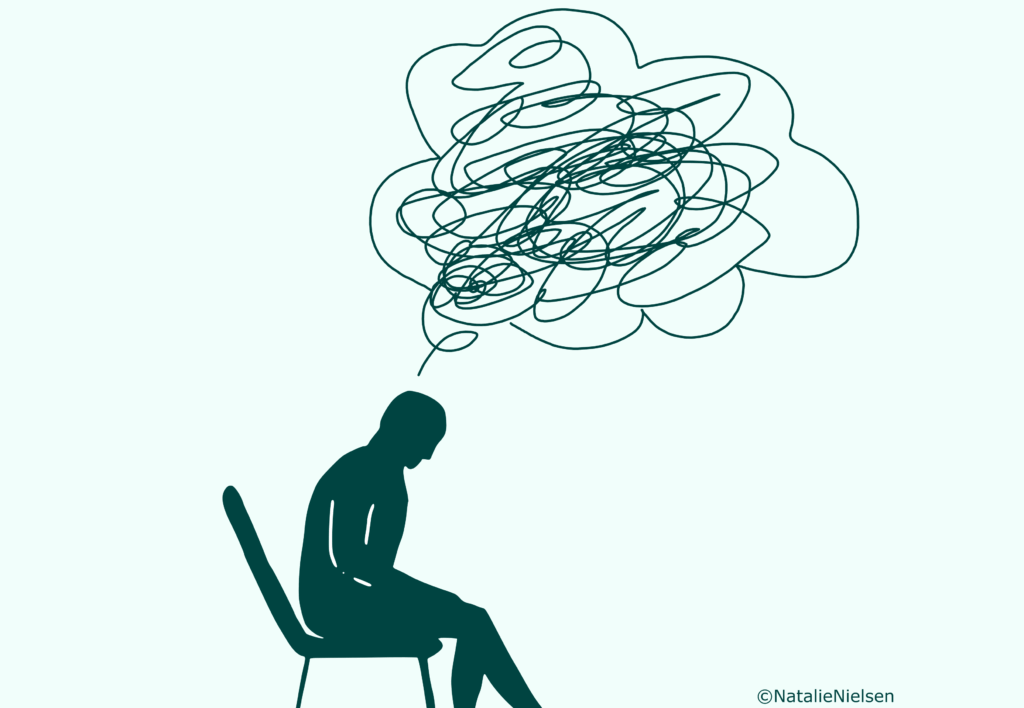
“If only I had…”, “Why did I do that?” – Repeating these kinds of thoughts about the past, without ever finding a solution, is called rumination. Rumination, , a persistent form of worrying about the past, is a core symptom of several psychiatric conditions such as depression and anxiety disorders. People who ruminate a lot often find that it affects their daily lives: it becomes harder to focus at work or school, social relationships can come under strain, and the joy in everyday activities can fade.
To learn how we can sustainably reduce rumination, researchers are working to better map the underlying neural mechanisms and possible treatment methods.
The ruminating brain
During rumination, certain brain areas become active that are part of the default mode network (DMN) – a network of regions involved when we’re resting, introspective, or focused on ourselves. Even at rest this network appears overactive in people who experience high levels of rumination.
Scientists generally focus on two main emotion regulation strategies: mindfulness and distraction. Both can reduce this DMN hyperactivity, though they seem to do so in different ways
Mindfulness appears to help regulate brain network activity and enables you to direct your thoughts more consciously. This so-called meta-cognitive skillcan support a more lasting reduction in rumination. Distraction, by contrast, can reduce DMN activity temporarily, but the effect often doesn’t last. Once the distraction ends, the thoughts tend to return easily, since they remain fresh in memory.
Mindfulness as solution?
Research has shown that several weeks of mindfulness training can help ease rumination and lower DMN activity. Less is known about the effects of brief mindfulness exercises without extensive training. However, one neurofeedback sstudy with adolescents experiencing depression found that a brief exercise – known as the Noting Practice – could reduce DMN activity.
Right now, scientists at the Donders Center for Cognitive Neuroimaging are studying whether such short mindfulness interventions might also be more effective and sustainable than distraction for people who ruminate but don’t have a clinical diagnosis. They’re looking at both brain activity and participants’ subjective experiences. The aim is to better understand rumination and develop more effective treatments to help relieve it.
Take part in the study
Are you a habitual overthinker? Does your mind often dredge up old memories or regrets? Help us discover what can truly help you break out of that vicious circle. Is it a mindfulness exercise? Or does distraction, like watching a thrilling series, work better for you? Check out here whether you’re a genuine overthinker and sign up for our study. Do you have a question, or would you like to participate? Then, email us at: overthinking-brain@donders.ru.nl
Credits
Author: Natalie Nielsen
Co-Author: Viane Favennec
Buddy: Lucas Geelen
Editor: Wieger Scheurer
Translation: Charlotte Sachs
Translation Editing: Amir Homayun
Image by Natalie Nielsen
About The Author
