This post is also available in .
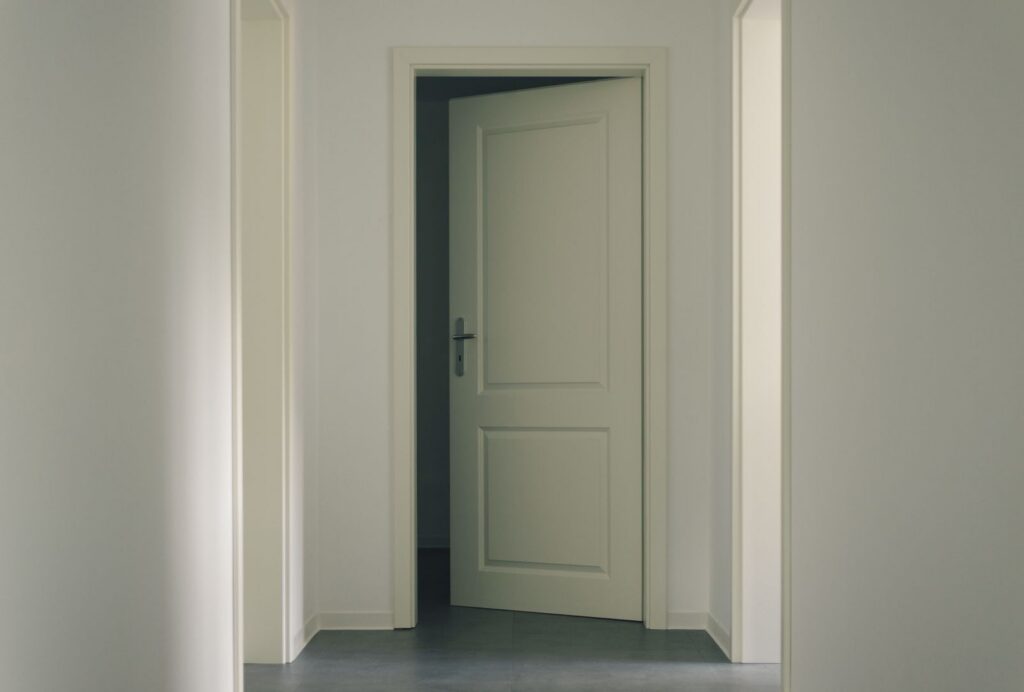
Don’t worry, you’re not losing your mind. You’ve just fallen victim to a sneaky brain glitch called the Doorway Effect (or Location Updating Effect). Sometimes, your brain’s internal GPS accidentally deletes your short-term memory the second you pass through a doorway.
Grid Cells Are Your Brain’s GPS
To understand why this happens, we first must look at your brain’s internal navigation system. Deep inside your brain sits a tiny, curved structure called the hippocampus, and right next to it is the medial entorhinal cortex. This region contains a network of highly specialized, navigational neurons called grid cells.
Think of grid cells like a built-in mapping system, drawing invisible lines to track where you are in a room. As you move, these cells activate regularly, in a triangular pattern keeping a real-time record of your location in a space, the distance you’ve walked and what is around you. They act like your brain’s very own Google Maps!
Why Doorways Wipe Your Memory
Here’s where things start to go wrong. The moment you step through a doorway, your brain hits the reset button. It treats the doorway like a chapter break in a book. Scientists call this an event boundary.
When your grid cells detect that the space around you has changed too much, when you’ve entered a new room, they don’t update your mental map. Instead, they delete it and start fresh. This is called global remapping, and it is a total reset of your spatial memory the second you cross a doorway.
The Survival Instinct Behind Your Forgetfulness
This is where your brain’s energy budget and your multitasking collide. Your memory is limited, and your brain burns a lot of your body’s fuel. To save energy, it assumes that once you cross a doorway, whatever you were thinking about in the previous room isn’t relevant to your survival anymore.
Normally, if you are fully focused, your brain has enough energy to load the new room’s map and keep your memory of the charger active. But if you were scrolling on your phone, planning your day, or distracted in general, your memory is already maxed out. So your brain is forced to make a quick decision: “What’s more important? Remembering a charger… or scanning for threats?” And survival wins. Every time.
This instinct to look for danger is something we inherited from our ancestors. Your brain prioritizes safety over other tasks. The result? You stand in the kitchen, wondering: “Why did I come in here?”
One Simple Fix For The Doorway Effect
Luckily, knowing that memory overload is the real trigger, means that you can easily protect yourself from the Doorway Effect. Research shows doorways don’t always make you forget. The effect only strikes when your brain is already preoccupied with other tasks.
The best way to remember what you went into a room for is to drop the multitasking. Before you stand up to grab that charger, put your phone down and focus on the one thing you want to do. By keeping your mental load light, you give your brain the processing space it needs to remember your goal. And if it still slips your mind? Blame the doorway. It’s the real culprit here.
Credits
Auteur: Eirini Papazoglou
Buddy & Editor: Rick Arends
Translation & Editor Translation: Lucas Geelen
About The Author
