This post is also available in .
Active particles are entities that spend energy to keep moving or changing, like bacteria, robot swarms, and proteins inside cells. They convert internal or environmental energy into directed motion or state changes, rather than being pushed passively by outside forces like leaves blown by wind. Their behaviour does not settle into equilibrium because they continuously burn fuel to prevent it. For example, many neural and cellular processes are biochemistry-powered, adaptive, and noisy. Active‑particle models let us test these messy, out‑of‑equilibrium effects in a controlled, simple way.
Microscopic level
The clearest meeting ground between the two fields is at the microscopic scale.
For example, inside axons, tiny molecular motors haul vesicles along cellular “tracks” using chemical energy. Physicists often model each vesicle as if it were a car on a single-lane road. One can expect jams, detours, and priority lanes. Such traffic-like slowdowns have been linked to the transport problems observed in some neurodegenerative conditions.
A second example comes from active drug delivery to the brain. Engineered nanoparticles, when propelled magnetically, acoustically, or by surface reactions, behave like active particles. They can stick and unstick from vessel walls and navigate chemical or mechanical gradients. Modeling them as active particles helps optimize how they cross the blood–brain barrier, avoid “dead ends” in microvessels, and accumulate at targets such as tumors or inflamed tissue. These behaviors, like clustering, persistence, and asymmetry, mirror classic active-particle properties.
Cellular level
Things don’t just need to move in space for an active particle system. For example, neurons spend energy to maintain ion gradients and adapt their firing. This makes the firing occur in a non-equilibrium mode. We can model these firing rates as active particles in an imaginary space. Where each unit can have a preferred direction (phase of firing) and persistence (how long it keeps firing a certain way), plus non-reciprocal interactions (A influences B more than B influences A). This asymmetry and non-equilibrium firing are the chief ingredients of an active-particle system.
Examples include phase-oscillator networks for brain rhythms, binary “spin” models that switch between quiescent and active states, and stochastic integrate-and-fire populations with adaptation as an internal, energy-using variable. These models uncover patterns that are hard to hand-craft. For example, they can show how limited “energy budgets” force circuits to trade speed for accuracy, or how metabolic and synaptic ‘budgets’ influence brain activity.
Macroscopic level
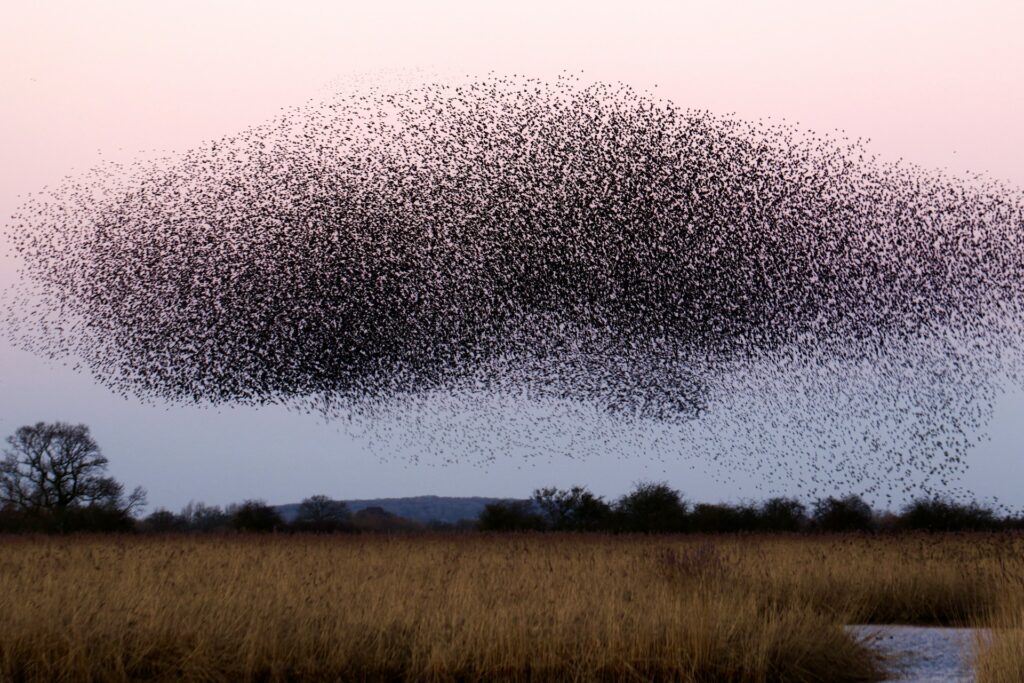
At larger scales, flocks of birds, schools of fish, migrating herds, and even cars in traffic are classic active-particle systems. Simple local rules yield lanes, swirls, sudden standstills, and migration behaviours.
Understanding how large groups self-organize helps us reason about stability, robustness, and failure modes in any complex system of many interacting units, including brains and societies. When mixed with genetic algorithms, such a model can help us simulate and analyse the mechanics of cultural evolution, where agents inherit and tweak the rules of communication and social norms. The ones that are efficient survive genetic selection.
Conclusion
Active particles aren’t a replacement for standard neuroscience; they’re another lens. By assuming energy-consuming units with local rules and noise. They tell us when and why activity self-organizes, which way influence flows, and how “aliveness” shows up in data. That makes active particles a practical companion for thinking about brains all the way from molecules to minds.
Author: Siddharth Chaturvedi
Buddy: Helena Olraun
Editor: Xuanwei Li
Translation: Wieger Scheurer
Editor Translation: Natalie Nielsen
About The Author
