
This post is also available in .
An intense world
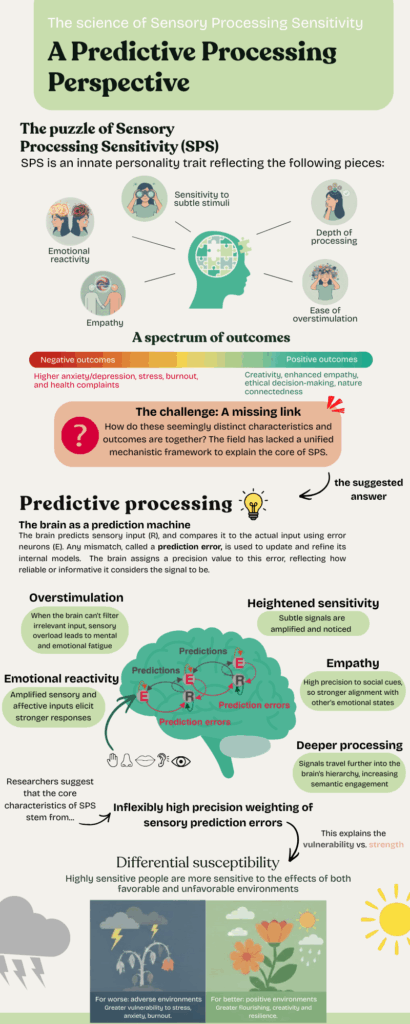
High sensitivity, also called Sensory Processing Sensitivity (SPS), is a personality trait that about one in five people have. It often shows a strong sensitivity to subtle stimuli, deeper processing of sensory information, intense emotions, and empathy. At the same time, people with SPS can become overwhelmed more quickly.
Research on high sensitivity has grown threefold in recent years, but we still do not fully understand the underlying mechanisms. A recent article in Trends in Cognitive Sciences offers a promising theoretical view. It is based on ideas about the predictive brain, also known as the ‘predictive processing framework’. Below is an explanation of why this idea can describe many features of SPS.
The brain as smart predictor
Have you ever been startled by unexpected sounds? Or felt that someone was about to say something before they did? This happens because your brain is always making predictions. According to the predictive processing model, your brain works like a smart predictor. It constantly guesses what you will see, hear, feel, smell, or taste.
Using patterns in sensory input, the brain builds an internal “map” of the world. This helps organize and filter incoming information.
When a prediction is wrong, for instance, when you expect another step on the stairs, or your slice of coconut spread is actually a slice of goat cheese, a prediction error occurs. This is the difference between what you expect and what actually happens. These errors help the brain update its internal map.
Our experience and expectations come from two directions. Sensory input comes from outside; this is called bottom-up. Expectations come from within; this is called top-down.
Your brain can give more or less importance to these two types of signals. It can adjust their “volume,” like turning a knob. It is important how these two knobs are balanced.
A common idea is that schizophrenia and hallucinations are linked to the strong influence of top-down signals. In this case, the top-down “knob” is too high, which changes how outside signals are experienced.
For SPS, the idea is the opposite. The bottom-up “knob” is higher. This makes the brain more sensitive to prediction errors, while other people’s brains are less critical of them.
Volume turned up
In highly sensitive people, the “volume” for bottom-up signals is set higher. Subtle stimuli enter the brain more deeply. As a result, emotions feel stronger and last longer. People may think more deeply about situations and see connections more quickly.
Because social signals carry more “weight”, highly sensitive people often recognize emotions in others faster and respond more to them. This explains their strong empathy. However, all of this takes a lot of energy.
The constant flow of stimuli can be tiring, especially in busy or chaotic environments. This can lead to stress, insecurity, and a lower quality of life. At the same time, because the bottom-up “volume” is higher, positive stimuli, such as music, art, or social connection, are also felt more strongly. This can lead to more creativity, empathy, and a strong sense of nuance and ethics.
One mechanism, two sides
Being highly sensitive may mean that the brain has a higher bottom-up “setting” than top-down. This makes it more sensitive to noise but also allows access to information that others filter out.
The predictive processing framework offers a possible explanation. It explains both the sensitivity and the strengths of one underlying brain mechanism. These insights may help to improve support, prevent overstimulation, and make better use of these strengths.
Maybe the brain of highly sensitive people is not simply too sensitive; it is just turned differently.
Credits
Author: Floor Ariaans
Buddy: Rick Arends
Translator: Rick Arends
About The Author
