This post is also available in .
When we talk about the human brain, we often picture the adult form – a fully folded cortex, distinct regions, complex circuits, continuous changes and overlapping functions. Yet the story of how this structure emerges is one of the most striking narratives in biology. Early brain development is an orchestrated progression of cellular decisions, migrations, and refinements that begins long before birth and sets the stage for everything that follows.
From a sheet of cells to a nervous system
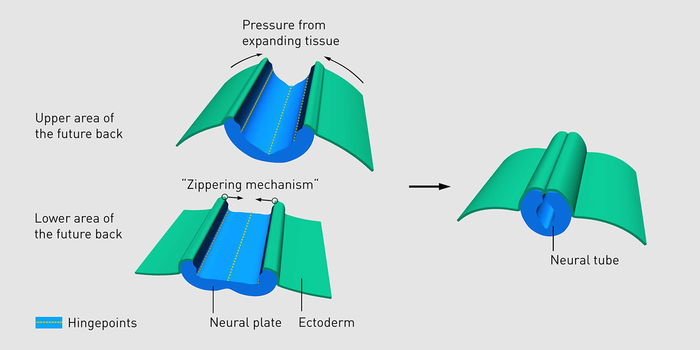
The brain’s origins lie in a simple structure: the neural plate, a flat layer of embryonic cells. Within days, this plate bends and fuses into the neural tube, the embryo’s first recognizable nervous system scaffold (Picture 1). This tube does not grow uniformly. Its anterior end (front part) expands rapidly, forming the forebrain, midbrain, and hindbrain, the main divisions of the mature brain.This uneven growth is exactly what creates the specialized regions we need. Growth rates differ across regions because the future cortex, thalamus, brainstem, and cerebellum require vastly different numbers of neurons and support cells, and they must form at different times.
Proliferation: generating the brain’s cellular population
Inside the neural tube, the “cell factory” called the ventricular zone drives an extraordinary expansion of neural cells. During peak proliferation, the developing human brain is estimated to produce roughly 250,000 neurons every minute. Progenitor cells, considered as “the parents” in the cell factories, divide in tightly regulated cycles. This process produces the neurons and glia that will populate the developing brain. During peak periods, millions of neurons are generated every hour. This rapid production forms the raw material for later organization.
Migration: building the cortical architecture
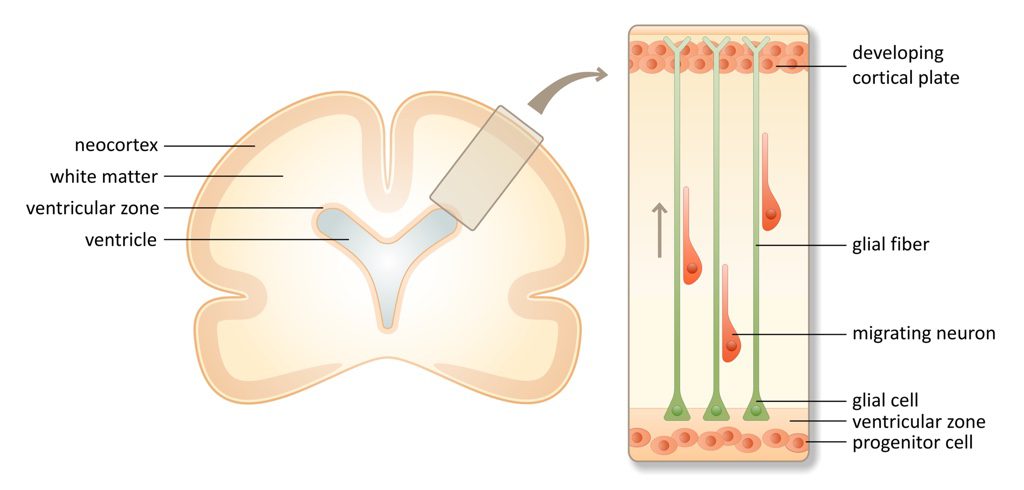
Most neurons do not stay where they are born. Instead, they migrate along radial glial fibers – highways that guides neurons to move long distances to find their correct layers and regions (Picture2). This migration is one of the defining events in cortical development. Cortical layers form in an “inside-out” sequence: the earliest neurons settle closest to the ventricles, while later neurons pass them to occupy more superficial layers.
Wiring the early network
Once neurons reach their destinations, they begin forming synapses. The young brain generates far more synapses than it will later maintain. This intentional overproduction provides a flexible template upon which experience can act. Similar to a sculptor chipping away stone to reveal the statue, synaptic pruning then trims back the brain’s early overgrowth, refining thousands of exuberant connections into the leaner, more efficient circuits.
A system designed for change
By the time an infant is born, the brain already reflects months of rapid construction: layering, migration, initial wiring, and early refinement. Yet its most important feature remains its plasticity. Early development does not aim to build fixed circuits; it aims to build a system capable of adapting.
Seeing the brain this way – not as a static structure but as an evolving architecture shaped by both biology and experience – highlights the extraordinary sophistication of its earliest stages. The foundations of thought, perception, and behavior are laid long before they are expressed, in a developmental process that is both precise and profoundly flexible.
Author: Xuanwei
Buddy: Amir
Editor: Helena
Translator: Dirk-Jan
Editor translation: Lucas
Cover Picture Source: by Europeana on Unsplash
Picture Source 1: Precursor of spine and brain forms passively
Picture Source 2: Zika virus blocks the neuron road
About The Author
